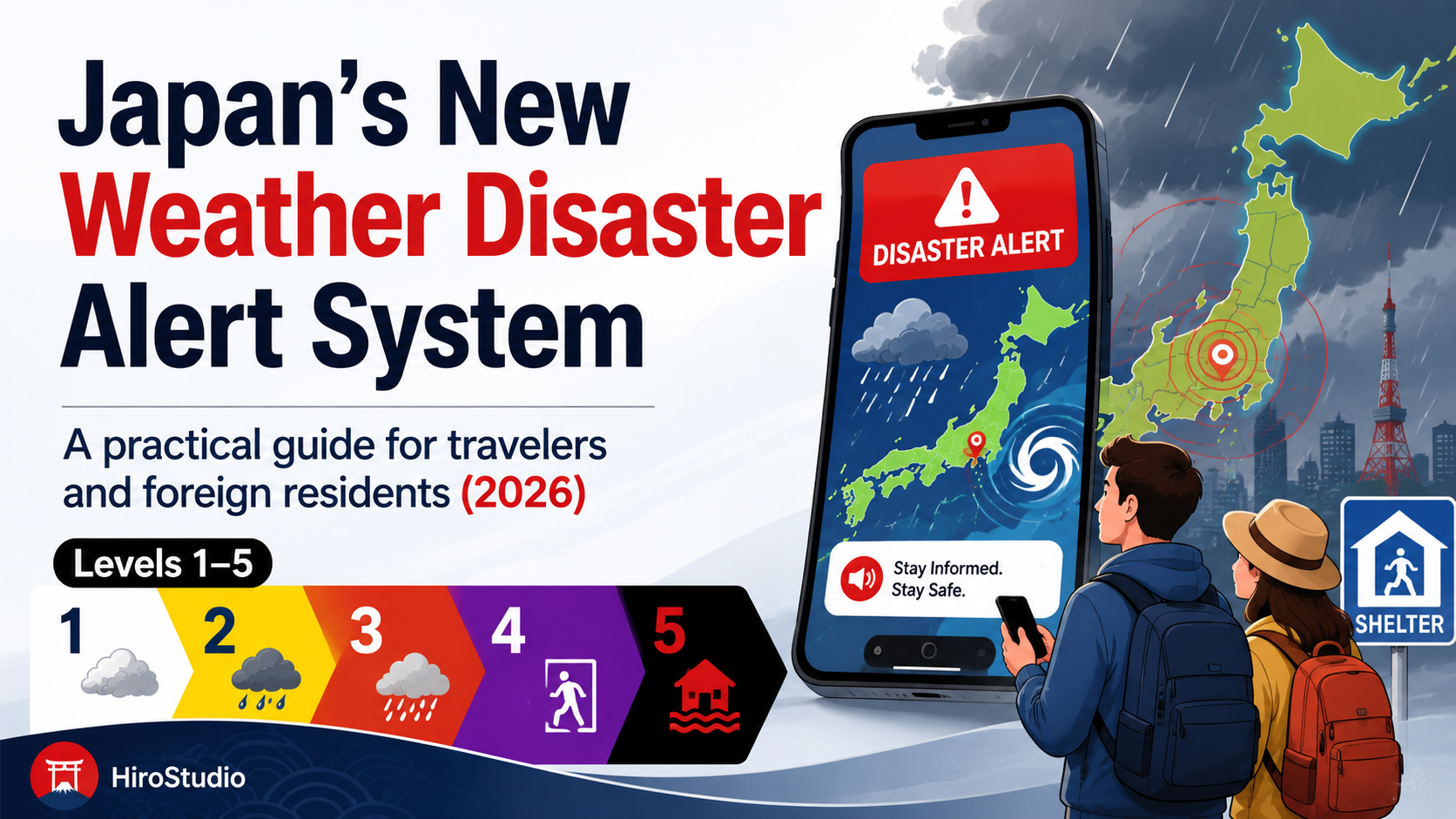
If you’ve ever seen a warning flash across your phone in Japan — red screen, Japanese text, an urgent alarm — and had no idea what to do next, you’re not alone. Japan’s disaster alert system is thorough, but for travelers and foreign residents it can be hard to read in the moment that matters most.
On May 29, 2026, the Japan Meteorological Agency (JMA) updated the system with one goal: make it easier to know when to act. The core change is simple — alert level numbers are now built directly into warning names. This guide explains what changed, what the colors mean, and when you should move.
The One Rule That Matters Most
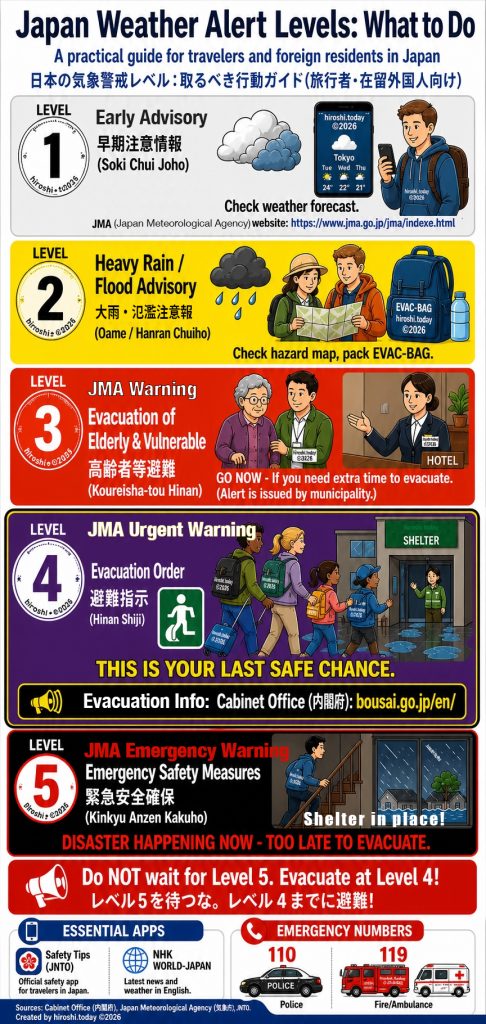
Before anything else: do not wait for Level 5 or black before acting. LEVEL 4 is the FINAL CHANCE for evacuation to the shelters.
By Level 5, a disaster may already be happening. Outdoor evacuation may no longer be safe. The system is designed to give you time at Level 3 — but that window closes fast.
5 Levels at a Glance
| Level | Color | English Name | What It Means | What You Should Do |
|---|---|---|---|---|
| 1 | ⬜ White | Early Advisory | Conditions may worsen | Monitor forecasts. Note your location. |
| 2 | 🟨 Yellow | Advisory | Weather deteriorating | Check updates. Review evacuation options. |
| 3 | 🟥 Red | Warning | Risk is rising | If you’re in a vulnerable area, start evacuating now. |
| 4 | 🟪 Purple | Urgent Warning | Life-threatening danger | Leave dangerous areas immediately. |
| 5 | ⬛ Black | Emergency Warning | Disaster may already be happening | Protect your life where you are right now. |
Source: JMA English Safety Leaflet
What to Do at Each Level
Level 1–2: Think ahead
Check forecasts. Note where your hotel or accommodation sits relative to rivers, slopes, and coastlines. Confirm transportation options. This is the time to plan, not act.
Level 3 Warning (Red): Start moving if you’re in a risky location
JMA’s guidance is that people who need more time to evacuate should start early at Level 3. If any of the following applies to your location, don’t wait:
- Near a river, canal, or coastal area
- In a low-lying or flood-prone area
- Near a slope, hillside, or mountain
- In a basement or underground facility
- In a coastal area during a typhoon
As a visitor unfamiliar with local geography, the safest default is: when in doubt at Level 3, move.
Level 4 Urgent Warning (Purple): Leave now
A disaster could happen at any time. Evacuate immediately from dangerous areas. Head to the nearest evacuation shelter (避難所, hinanjo) or move to higher ground. Level 4 is the absolute deadline — the government’s goal is for everyone to have already evacuated before this point.
Level 5 Emergency Warning (Black): Protect your life where you are
Flooding or landslides may already be occurring. Outdoor evacuation may no longer be safe. Move to the highest floor in your building. Move away from slopes and rivers. The goal is immediate protection — not reaching a shelter.
One Tool to Bookmark: KIKIKURU
KIKIKURU is JMA’s real-time hazard map. It shows color-coded risk levels for your exact location across three hazard types: landslides, flooding (inundation), and river flood risk — updated approximately every ten minutes.
A general warning may cover an entire city or prefecture. KIKIKURU tells you what’s happening where you actually are. Bookmark it now, before you need it. Note that storm surge is not covered by KIKIKURU — for storm surge risk, check JMA’s official warnings and your local government’s hazard maps.
How to Get Alerts in English
Three resources worth having before an emergency:
- Safety Tips app — push notifications in 15 languages, managed by the Japan Tourism Agency. The most practical option for real-time alerts while traveling.
- JMA English weather warning map — official warnings displayed in English by region.
- NHK WORLD — English-language disaster news from Japan’s public broadcaster.
For Residents: Understanding the Full System
The section above covers what travelers need to know. If you live in Japan or want to understand the system in more depth, here is the fuller picture.
What Changed on May 29, 2026
The update formally took effect on May 29, 2026, with a system switchover beginning the afternoon of May 28. It was developed following two and a half years of expert deliberations (January 2022 – June 2024) by JMA’s Disaster Weather Information Review Committee, and backed by amendments to the Meteorological Business Act and the Flood Control Act.
The core problems the update addresses: weather disaster alerts and Japan’s five-level evacuation system had overlapping, inconsistently named categories that were difficult to match in real time — especially for people unfamiliar with how the two systems related to each other.
The main changes, per JMA’s official overview document:
- For river flooding, heavy rain, landslides, and storm surge information, all warning names now include the level number directly (e.g., Level 3 Warning (Heavy rain), Level 4 Urgent Warning (Heavy rain)). Note that other warnings such as strong wind, high waves, and heavy snow are not part of this five-level framework and are unchanged.
- A new Level 4 Urgent Warning (危険警報, kiken keihō) was created for each hazard type, filling a gap between ordinary warnings and special warnings
- A new Level 5 Flood Special Warning (レベル5氾濫特別警報) was established for major rivers — a category that did not previously exist
- Information for river flooding, heavy rain, landslides, and storm surge is now consistently organized under the five-level framework
Source: JMA, “Improvements to Disaster Weather Information” (overview document, updated February 2026)
Official Warning Names by Hazard Type
In the updated system, each alert is issued under a name that combines the hazard type and the level. The four hazard types are: river flooding (氾濫), heavy rain (大雨), landslide (土砂災害), and storm surge (高潮). The table below shows the full set of names as defined by JMA.
| Level | River Flooding | Heavy Rain | Landslide | Storm Surge |
|---|---|---|---|---|
| 5 | Level 5 Emergency Warning (Flood) レベル5氾濫特別警報 ★ New | Level 5 Emergency Warning (Heavy rain) レベル5大雨特別警報 | Level 5 Emergency Warning (Landslide) レベル5土砂災害特別警報 | Level 5 Emergency Warning (Storm surge) レベル5高潮特別警報 |
| 4 | Level 4 Urgent Warning (Flood) レベル4氾濫危険警報 | Level 4 Urgent Warning (Heavy rain) レベル4大雨危険警報 | Level 4 Urgent Warning (Landslide) レベル4土砂災害危険警報 | Level 4 Urgent Warning (Storm surge) レベル4高潮危険警報 |
| 3 | Level 3 Warning (Flood) レベル3氾濫警報 | Level 3 Warning (Heavy rain) レベル3大雨警報 | Level 3 Warning (Landslide) レベル3土砂災害警報 | Level 3 Warning (Storm surge) レベル3高潮警報 |
| 2 | Level 2 Advisory (Flood) レベル2氾濫注意報 | Level 2 Advisory (Heavy rain) レベル2大雨注意報 | Level 2 Advisory (Landslide) レベル2土砂災害注意報 | Level 2 Advisory (Storm surge) レベル2高潮注意報 |
Source: JMA overview document; English rendering of warning names based on JMA official English notation (PDF)
Two Systems Working Together: JMA Warnings and Municipal Evacuation Orders
Japan’s disaster response involves two parallel systems that work at different levels. Understanding the distinction matters if you live here.
JMA weather warnings (the focus of this article) are issued by the Japan Meteorological Agency based on meteorological and hydrological data. They are national-level technical assessments of hazard risk — and the updated names now reflect the warning level directly.
Municipal evacuation orders are issued by local governments (市町村, shichōson) based on JMA warnings and local conditions. These include:
- Level 3: 高齢者等避難 (Evacuation for elderly and others who need more time)
- Level 4: 避難指示 (Evacuation order — all residents in dangerous areas)
- Level 5: 緊急安全確保 (Emergency safety securing — issued when disaster is imminent or already happening)
A common point of confusion: 緊急安全確保 (kinkyū anzen kakuho) is sometimes described as a “Level 5 alert,” but this refers to the municipal evacuation order, not the JMA weather warning. The corresponding JMA weather warning at Level 5 is 特別警報 (Special Warning), such as レベル5大雨特別警報 (Level 5 Heavy Rain Special Warning). Both signal the same danger, but they are issued by different bodies.
Source: Cabinet Office (Disaster Management), “Guidelines on Evacuation Information”; 2026 revision materials (March 2026, PDF, Japanese)
The “Flood Warning” Detail: Not All Rivers Are Covered the Same Way
One of the less obvious aspects of the updated system involves how river flooding is handled. Under the new framework, major designated rivers (洪水予報河川) receive their own dedicated flood warnings — issued jointly by river management authorities and meteorological offices, on a river-by-river basis. The new Level 5 Flood Special Warning (レベル5氾濫特別警報) applies specifically to these major rivers.
For smaller rivers, urban areas, and inundation not covered by designated flood forecasts, the relevant information is issued under the heavy rain (大雨) series instead. This means the absence of a named flood warning for a small river near you does not mean the area is safe — check KIKIKURU for your specific location.
Source: JMA overview document, “River Flooding and Heavy Rain Information” section
Special Notes: Landslides and Storm Surge
Landslide risk can escalate rapidly during heavy rain and may give little visible warning before it is too late. One notable change in the updated system: the former “Landslide Warning Information” (土砂災害警戒情報) has been restructured as the Level 4 Urgent Warning (Landslide). This means a Level 3 Warning (Landslide) should be treated as a strong signal that conditions may quickly reach Level 4 — do not treat Level 3 as a reason to wait.
Storm surge carries a different kind of risk: strong winds during a typhoon can make late-stage outdoor movement dangerous or impossible. JMA guidance notes that storm surge requires earlier action than many other hazards, because conditions can deteriorate faster than expected once a typhoon approaches.
Frequently Asked Questions
When did Japan’s new weather alert system take effect?
The updated system began rolling out on the afternoon of May 28, 2026, and formally took effect on May 29, 2026. It was developed following two and a half years of expert deliberations (January 2022 – June 2024) by JMA’s Disaster Weather Information Review Committee. Note that Level 1 (Early Advisory) is not an evacuation alert — it means “be aware; conditions may worsen.” Evacuation action starts at Level 3. (JMA special page)
What does Level 3 Warning mean, and should I evacuate?
Level 3 Warning (red) means danger is rising. JMA guidance specifies that people who need more time to evacuate — including elderly residents, people with mobility limitations, and visitors unfamiliar with local routes — should start evacuating early at this level. If you are in a vulnerable location (near a river, slope, coast, or low-lying area), do not wait for Level 4. (JMA English leaflet)
What is KIKIKURU and how do I use it?
KIKIKURU (キキクル) is JMA’s official real-time hazard map, available at jma.go.jp/bosai/risk. It displays color-coded risk levels for your specific location across three hazard types: landslides, flooding (inundation), and river flood risk — updated approximately every ten minutes. Note that storm surge is not covered; for storm surge risk, check JMA’s official warnings and local hazard maps. Bookmark KIKIKURU before you need it.
What is the difference between Level 4 Urgent Warning and Level 5 Emergency Warning?
Level 4 Urgent Warning (purple — 危険警報) means a disaster could happen at any time. Evacuate immediately from dangerous areas. Level 5 Emergency Warning (black — 特別警報) means a disaster may already be occurring and outdoor evacuation may no longer be safe. At Level 5, move to the highest floor in your building and away from slopes, rather than attempting outdoor travel. (JMA English leaflet)
What is 緊急安全確保 (kinkyū anzen kakuho) — is that different from the Level 5 JMA warning?
Yes. 緊急安全確保 is a Level 5 evacuation order issued by local municipalities (city/town governments) when a disaster is imminent or already happening. The corresponding JMA weather warning at Level 5 is 特別警報 (Special Warning) — for example, Level 5 Heavy Rain Special Warning (レベル5大雨特別警報). Both signal the same level of danger, but they are issued by different authorities. (Cabinet Office Evacuation Guidelines)
How can I receive real-time disaster alerts in English while in Japan?
Download the Safety Tips app (managed by the Japan Tourism Agency), which provides push notifications in 15 languages including English. You can also monitor the JMA English weather warning map and NHK WORLD for English-language disaster news.
Official Resources
- JMA — 2026 Disaster Weather Information Update (Special Page, Japanese)
- JMA — Official English Alert Name Notation (PDF)
- JMA — English Safety Leaflet (PDF)
- JMA — Full Overview Document (PDF, Japanese)
- JMA — FAQ (PDF, Japanese)
- KIKIKURU — Real-Time Hazard Risk Map
- JMA — Weather Warnings in English
- Cabinet Office — Guidelines on Evacuation Information (Japanese)
- Cabinet Office — 2026 Evacuation Guideline Revision Materials (PDF, Japanese)
- Safety Tips App — JNTO / Japan Tourism Agency (15 languages)
- JNTO — Safe Travel Information
AI tools were used in parts of the research and drafting process for this article. Information reflects sources available as of May 2026 and is subject to change. I do my best to ensure accuracy, but I cannot guarantee completeness — please verify details at official sources before making decisions based on this content.



Hiroshi is a Tokyo-based project manager specialising in international operations within the global MedTech company. Originally from Hokkaido, he holds a postgraduate degree in international relations — including study periods in the United States and Sweden — and has lived and worked across Malaysia, Switzerland, China, and the Philippines.
Beyond his industry career, he served as Manager for the 23rd World Scout Jamboree in 2015, where he managed liaison with delegations from over 150 countries, coordinated with the World Organisation of the Scout Movement (WOSM), and led on-site risk response. He has also contributed to disaster relief efforts following the Great East Japan Earthquake and other natural disasters across Japan.
This blog covers travel, productivity, technology, and global careers — written as a way of thinking through ideas and consolidating what he learns along the way.
Discover more from hiroshi.today
Subscribe to get the latest posts sent to your email.