※ Related posts on the Claw credit drain issue:
[Related post ①] Genspark Claw Credits Disappearing? I Fixed a 2,000/Day Drain — Here’s How
[Related post ②] My Genspark Credits Keep Disappearing — And I’m Not Even Using It
I ran low on Genspark credits and went to buy a top-up — something I’d done several times before without thinking much about it. The “Add More Credits” button was still there. I clicked it. What came up wasn’t a credit pack purchase screen. It was a subscription upgrade prompt. I dug around a bit and confirmed what I suspected: sometime around March 2026, Genspark quietly removed the option to buy standalone credit packs. No announcement. No email. Just gone. This post is my attempt to document what actually changed, why I think Genspark made this call, and where I still disagree with their approach.
The short version
Contents
- Genspark used to sell one-time credit packs (10,000 credits for $20, valid 3 months). Those are no longer available. When you run out of credits, your only options are to upgrade your subscription tier or wait until your monthly reset.
- For Claw users, this is a compounding problem: Claw’s heartbeat tasks quietly drain credits in the background, and now there’s no quick way to refill if things go wrong.
- On April 8, Genspark’s CEO addressed credit consumption issues directly on a YouTube Live stream. What he said is worth knowing — both for understanding their reasoning and for managing your own usage.
What Genspark used to offer
Before March 2026, Genspark’s credit model had a useful safety valve: one-time credit packs you could buy on top of your subscription. The most common option was 10,000 credits for $20, valid for three months. If you had a heavy month — a big project, a deadline, or just an unexpected spike in usage — you could top up without touching your subscription tier. It was a flexible, pay-as-you-go layer on top of the base plan, and it worked well for anyone whose usage wasn’t perfectly predictable month to month.
That option is gone now. The official help center page for “How do I get more credits?” used to reference credit pack purchases. It now says the most straightforward path is to upgrade your plan. Users on r/genspark_ai started flagging this around March 16, when one user reported hitting “Add More Credits” and getting charged a prorated upgrade fee instead — over $20, without clearly realizing what was happening.
It’s also worth noting that the new system isn’t purely a step backward on every dimension. Genspark has expanded the number of credit tiers available within Plus and Pro plans — you can now choose from several monthly credit allocations rather than being locked into a single amount. That’s a genuine improvement in terms of matching your plan to your actual usage. The frustration is that this flexibility only works in one direction: you can pick the tier that fits, but if you need a one-time top-up mid-cycle, there’s no good answer anymore.
Current plan structure
For reference, here’s roughly how the current Plus tier pricing breaks down:
| Plan | Monthly (USD) | Credits/month |
|---|---|---|
| Plus (entry) | $24.99 | 10,000 |
| Plus (mid-tier example) | $74.99 | 32,000 |
| Pro (entry) | $249.99 | 125,000 |
If you’re on the 10,000-credit Plus plan and hit zero mid-month, upgrading to the next meaningful tier jumps you to $74.99/month. The difference is charged immediately on a prorated basis, and the higher tier carries forward into subsequent months until you manually downgrade. What used to cost $20 as a one-time purchase now requires a permanent-until-you-change-it subscription change. That’s a meaningful shift in how you have to think about credit management.
Why this hits Claw users harder
Genspark Claw is an autonomous AI agent that runs scheduled tasks — what the system calls “heartbeat” tasks — in the background, on a recurring basis. Every time one of those tasks fires, it consumes credits. This is by design: Claw can check your email, run research, monitor feeds, and send you summaries while you’re doing something else entirely. That’s the value proposition. The tradeoff is that credits disappear even when you’re not actively using the interface.
I’ve experienced this directly — a bug in Claw (an “auth is not defined” loop) burned through credits I hadn’t planned to spend. Previously I could have bought a credit pack to patch the gap. Now the options are upgrade or wait. The community has seen larger-scale versions of this: reports on r/genspark_ai from March–April 2026 describe cases where enabling OpenClaw led to 25,000 credits disappearing overnight with no manual activity, and a single data migration command consuming 10,000 credits instantly. In both cases, the usage logs showed little detail about what actually happened. The removal of top-ups turns what was an inconvenience into something with no good short-term resolution.
Across r/genspark_ai, the sentiment pattern is consistent: users want the option to buy more credits when they need them, without being forced to permanently raise their subscription tier. Annual plan subscribers are in a particularly awkward spot — they can’t easily downgrade mid-year, and they can’t add credits without upgrading. There are also reports of the “unlimited” AI chat and image generation (advertised as credit-free on paid plans) consuming credits in some cases, which adds another layer of unpredictability to usage management.
What Genspark’s CEO said on April 8
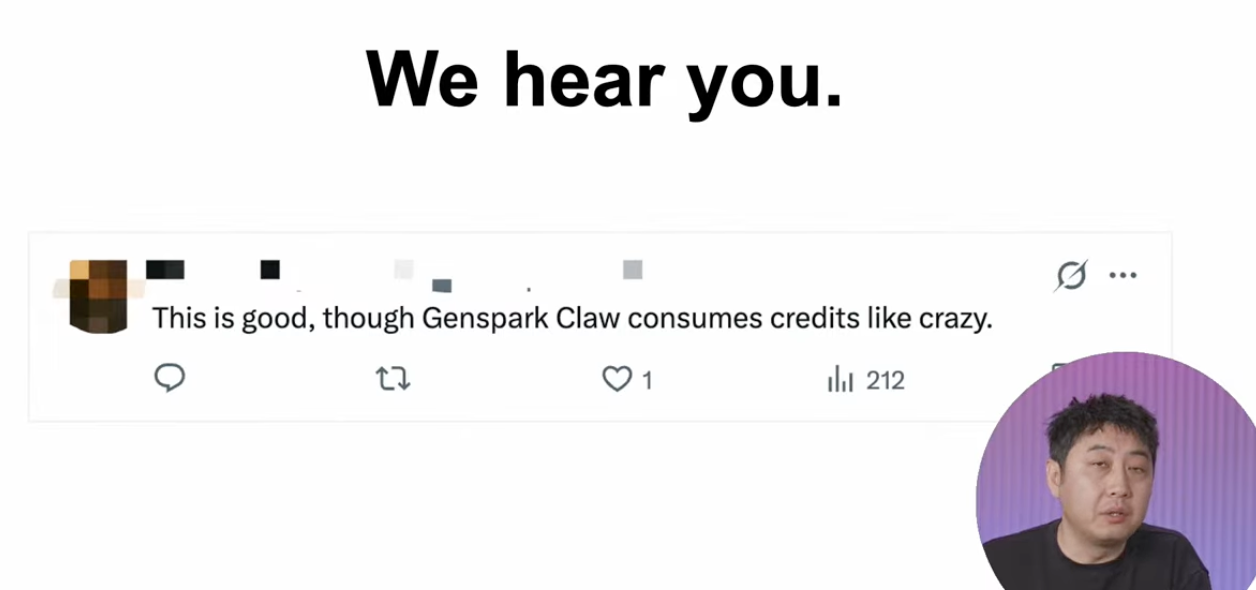
On April 8, Genspark held a YouTube Live stream to announce AI Workspace 4.0. I watched it, and what stood out was that CEO Eric Jing opened the session not with the product launch, but with a Q&A segment addressing the most common user complaints — directly and by name. That’s not nothing.
The first question taken up was “Claw consumes credits like crazy — why?” (around 2:03). Eric didn’t deflect. He confirmed it’s true, then explained the heartbeat mechanism: scheduled tasks run on a recurring cycle (every few minutes by default), and each execution consumes credits proportional to task complexity (around 3:18). The fixes they’re working on: switching heartbeat tasks to smaller, cheaper models; giving users a toggle to pause or disable specific heartbeat tasks; and adding warnings before credit-heavy operations fire (around 4:44). He described reducing credit consumption as a top priority (around 6:25).
On support response times (around 11:34), he acknowledged the obvious problem: Genspark is a 70-person team, and only two of those people work on customer support. That number surprised me, honestly — $250M ARR on 70 people is an impressive ratio, but it does explain why the support queue is overwhelmed. He committed to hiring more and building AI-assisted support workflows (around 11:52).
My read on all this: Genspark knows about the problems. The credit top-up removal has a business logic behind it — predictable subscription revenue is easier to plan infrastructure around than sporadic bulk purchases, and maintaining separate credit pack inventory, expiration tracking, and priority handling adds operational complexity. I don’t think it’s an unreasonable call from a product management perspective. But the execution — no communication, no transition period, a button that still says “Add More Credits” but does something different — is harder to defend. And the gap it creates for users with variable usage or unexpected consumption events is real.
If I were to suggest an alternative model: usage-tiered top-ups, where the per-credit price decreases as you buy more, would give Genspark better revenue predictability than flat-rate packs while giving users a reason to manage consumption thoughtfully. It’s a model that would work better for both sides than the current binary of “wait or upgrade permanently.”
What you can actually do right now
If you’re low on credits and don’t want to upgrade, the most practical move is to lean hard on the features that don’t consume credits: AI Chat and AI Image Generation are included without credit cost on paid plans through December 31, 2026, so shifting work toward those buys time until your monthly reset. That said, there are reports of these “unlimited” features consuming credits in edge cases, so it’s worth monitoring. If you do need to upgrade, be clear-eyed that the new tier persists — it won’t automatically revert next month. And if you want Genspark to bring back top-up options, saying so in r/genspark_ai or through their support channels is worth doing — the April 8 stream suggests at least some feedback is getting through.
To be direct about where I am: for the past few weeks, my Genspark subscription has functionally become a pass to use other AI models through Genspark’s chat interface for free, because I’ve been holding back on the agent features I actually want to use — Claw, Super Agent — due to credit uncertainty. I suspect I’m not alone in this. The new Claw for Desktop feature announced on April 8 looks genuinely useful, but I’m not going to test it until I have confidence that unexpected consumption won’t leave me stranded until month-end with no way to refill.
Four things I’m still asking for
The April 8 stream gave me some confidence that Genspark is moving in the right direction on the technical side. But the three things I’ve been asking for since my earlier posts on this haven’t changed: transparent credit usage breakdowns (what specifically consumed what, when), automatic credit consumption pause when errors are detected, and some form of flexible top-up option. The first two are probably harder engineering problems. The third seems like it should be more tractable — and it’s the one that would have the most immediate impact on user trust. I’ll keep an eye on how this develops and report back when something changes.
The fourth item is one I’d frame more as a product design suggestion than a complaint: pre-execution cost estimation. Before Claw or any agent starts a task, it should surface a projected credit range and ask for confirmation — something like “this task is estimated to use 800–1,200 credits, proceed?” And if actual consumption during execution starts tracking significantly above that estimate, the agent should pause and check in rather than running to completion and presenting the bill afterward. This kind of spend-gating is already standard in cloud infrastructure tools — AWS and GCP both surface cost warnings before you provision something expensive — and it’s a reasonable expectation for an AI agent platform that bills by consumption. It would also make the heartbeat issue far less stressful: if a scheduled task is about to cost more than expected, you’d know before it’s too late to do anything about it.
Note: AI tools were used for parts of the research and drafting process for this post.
Tags: Genspark, Claw, credits, subscription, pricing, AI tools, AI workspace



Hiroshi is a Tokyo-based project manager specialising in international operations within the global MedTech company. Originally from Hokkaido, he holds a postgraduate degree in international relations — including study periods in the United States and Sweden — and has lived and worked across Malaysia, Switzerland, China, and the Philippines.
Beyond his industry career, he served as Manager for the 23rd World Scout Jamboree in 2015, where he managed liaison with delegations from over 150 countries, coordinated with the World Organisation of the Scout Movement (WOSM), and led on-site risk response. He has also contributed to disaster relief efforts following the Great East Japan Earthquake and other natural disasters across Japan.
This blog covers travel, productivity, technology, and global careers — written as a way of thinking through ideas and consolidating what he learns along the way.
Discover more from hiroshi.today
Subscribe to get the latest posts sent to your email.